
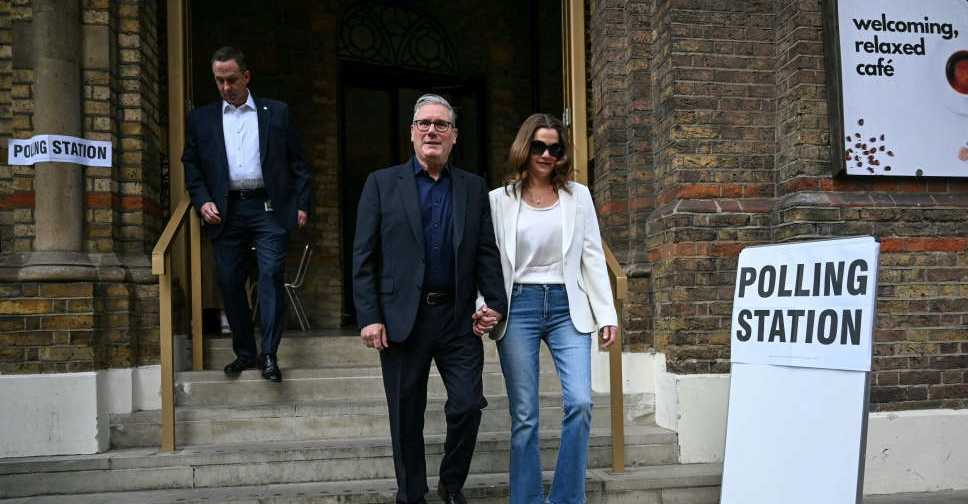
Prime Minister Keir Starmer vowed on Friday to fight on to deliver on his promise to bring "change" to Britain after his Labour Party suffered heavy losses in local elections that deepened doubts over his ability to govern.
Just under two years after winning a landslide national election, Starmer saw voters punish his Labour government, dealing it a blow in some of its traditional strongholds in former industrial regions in central and northern England.
The main beneficiary was the populist Reform UK party of Brexit campaigner Nigel Farage, which gained more than 350 council seats in England, and could form the main opposition in Scotland and Wales to the pro-independence Scottish National Party and Plaid Cymru in results later on Friday.
The early results confirmed the fracturing of Britain's traditional two-party system into a multi-party democracy, in what analysts say represents one of the biggest transformations in British politics in the last century.
The once-dominant Labour and Conservative parties were losing votes to Reform, to the left-wing Green Party at the other end of the political spectrum, and to the nationalists in Scotland and Wales.
MY RESOLVE IS NOT WEAKENED, SAYS STARMER
Despite the losses, Starmer's allies signalled their support for a man whose popularity ratings have sunk to among the worst for any British leader, and the prime minister visited one bright electoral spot for his party to say he would press on.
"I am not going to walk away," he told reporters in Ealing, west London, where Labour retained control of the council. He said voters were more concerned about the pace of change rather than his leadership.
He promised to set out the steps needed to change Britain - signalling the latest reset by a government that has struggled to translate its vision for the country to voters or tackle a cost-of-living crisis that has been compounded by conflicts in Ukraine and Iran.
But there was no denying the scale of the losses for Labour in elections for 136 local councils in England, and the devolved parliaments in Scotland and Wales - the most significant test of public opinion before the next general election due in 2029.
"The picture has been pretty much as bad as anyone expected for Labour, or worse," said John Curtice, Britain's most respected pollster.
Some Labour lawmakers have said if the party performs poorly in Scotland, loses power in Wales, and fails to hold many of the roughly 2,500 council seats it is defending in England then Starmer will face renewed pressure to quit or at least set out a timetable for his departure.
Starmer's allies warned it was not the time to move against him, with defence minister John Healey saying the last thing voters wanted was "the potential chaos of a leadership election" and that he believed the British leader could still deliver.
INSURGENT PARTIES FRACTURE TWO-PARTY SYSTEM
Reform UK leader Farage said the results so far represented a "truly historic shift in British politics".
Labour was wiped out in some early results.
The party lost control of the council of Tameside in Greater Manchester in northern England for the first time in almost 50 years after Reform picked up all 14 seats Labour was defending.
In nearby Wigan, which it has controlled for more than 50 years, Labour lost every one of the 20 seats it was defending to Reform.
Reform also took control of a London borough for the first time, winning 30 of the 43 council seats in Havering, in the east of Britain's capital.
While incumbent governments often struggle in mid-term elections, pollsters forecast that Labour could lose the most council seats since Conservative former Prime Minister John Major lost more than 2,000 in 1995, when his government was mired in endless corruption scandals.
The Reform UK party added 367 council seats in England in early results. Labour lost 254 seats and the Conservative Party was down 146 seats.
Most of the results - including for the Scottish and Welsh elections - are due to be declared later on Friday.
U-TURNS AND SCANDALS ERODE STARMER'S AUTHORITY
Starmer, a former lawyer, was elected in 2024 with one of the largest parliamentary majorities in modern British history offering stability after years of political chaos.
But his time in office has been marked by policy U-turns, a rotating cast of advisers and the appointment of Peter Mandelson as Britain's ambassador to the United States who was fired nine months into the job over his links to the late convicted offender Jeffrey Epstein.
Any move to oust him might not be imminent. Two frontrunners to succeed him if he goes - Greater Manchester mayor Andy Burnham and former Deputy Prime Minister Angela Rayner - are not yet in positions to mount leadership bids, and other rivals seem unwilling to move against him for now.

 US halts flights at busy East Coast airports due to communications issues
 MS NOW, CNN and Politico to sue over White House ban
 Pakistan says it killed 28 militants, Afghan Taliban and UN report 3 civilian deaths
 New air traffic control failure delays flights at UK airports
 Textile factory fire in southern Chinese city of Foshan kills 8