

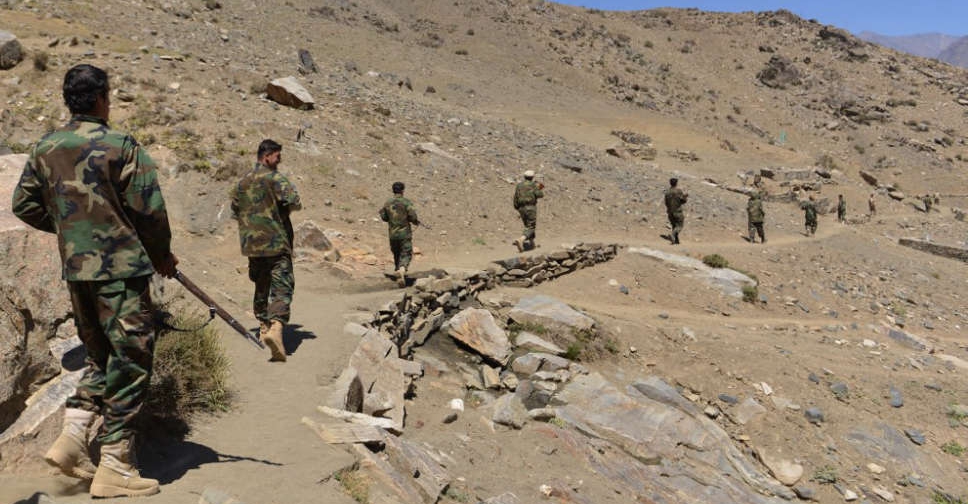
The Taliban claimed victory on Monday over opposition forces in the Panjshir valley northeast of Kabul, completing their takeover of the country following the stunning capture of Kabul last month and the chaotic withdrawal of foreign troops.
Pictures on social media showed Taliban members standing in front of the gate of the Panjshir provincial governor’s compound after fighting over the weekend with the National Resistance Front of Afghanistan (NRFA), led by Panjshiri leader Ahmad Massoud.
"Panjshir province completely fell to the Islamic Emirate of Afghanistan," spokesman Zabihullah Mujahid said on Monday, adding that some enemy fighters had been killed in battle and others had fled.
"With this victory and latest efforts our country has come out of the whirlpool of the war and our people will have a happy life in peace, liberty and freedom in the entire country.”
The Taliban assured the people of Panjshir, who are ethnically distinct from the Pashtun-dominated Taliban and fought against the Islamists during their 1996-2001 rule, that there would be no "discriminatory act against them".
"They are our brothers and would work together for a joint purpose and welfare of the country," Mujahid said.
There was no immediate word from Massoud, who leads a force made up of remnants of regular Afghan army and special forces units as well as local militia fighters.
The Taliban said on Sunday that their forces had made it into the provincial capital, Bazarak, and had captured large quantities of weapons and ammunition.
As fighting raged in the valley on Sunday, Massoud said he welcomed proposals from religious scholars for a negotiated settlement. Several attempts at talks were held after clashes erupted about two weeks ago but eventually broke down, with each side blaming the other for their failure.
The Taliban seized control of the rest of Afghanistan three weeks ago, taking power in Kabul on August 15 after the Western-backed government collapsed and President Ashraf Ghani fled the country.
Panjshir was the last pocket of armed resistance against the Taliban. It has a history of being difficult for enemies to take. The rugged mountain valley is still littered with the wreckage of tanks destroyed during the long war against the Soviet Union in the 1980s.


 Afghanistan says Pakistani airstrikes kill at least three
 New air traffic control failure delays flights at UK airports
 Textile factory fire in southern Chinese city of Foshan kills 8
 Typhoon approaches eastern Japan, prompts flood and landslide warnings
 Australia to seek UN Security Council seat from 2029