

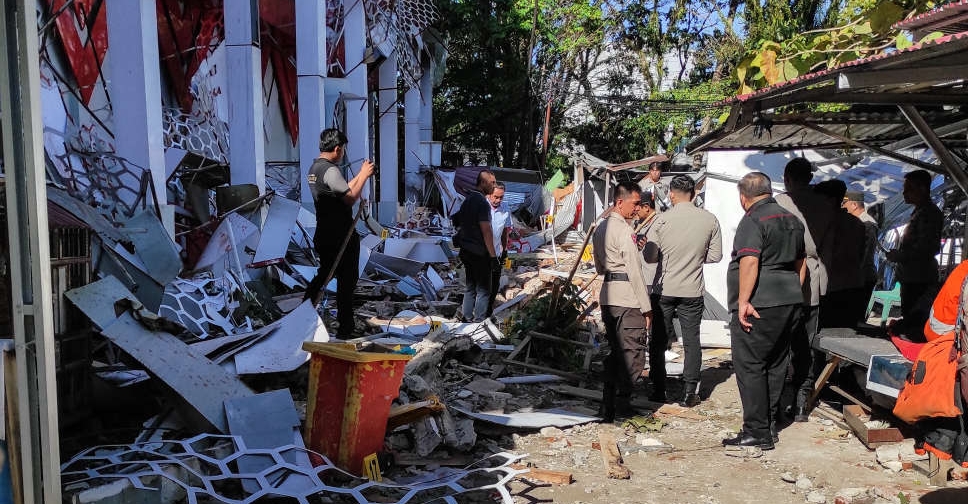
An earthquake of magnitude 7.6 has struck in Indonesia's Northern Molucca Sea on Thursday, killing one person, damaging some buildings, and triggering tsunami waves, authorities and witnesses said.
Indonesia's meteorology agency BMKG said there were tsunami waves reported in five locations, the highest at 0.75 metres in North Minahasa in North Sulawesi, and about 50 aftershocks were monitored, the largest at a magnitude of 5.8.
BMKG chief Teuku Faisal Fathani told a press conference that its modelling indicated there was tsunami potential for waves of 0.5 to 3 metres high.
US tsunami warning authorities initially said hazardous tsunamis were possible along the coasts of Indonesia, the Philippines, and Malaysia within 1,000 km of the epicentre, but later lifted the threat warning.
One person was killed by falling rubble in the Manado area when part of a building used by the local sports authority collapsed, deputy chief of North Sulawesi police Awi Setiyono told reporters.
Indonesia straddles the "Pacific Ring of Fire", a highly seismically active zone, where different plates on the earth’s crust meet and create a large number of earthquakes and activity in some of the country's more than 130 active volcanoes.
DISASTER AGENCY URGES VIGILANCE
Indonesia is a tectonically complex part of the "Pacific Ring of Fire", a seismically active belt of volcanoes stretching from South America to the Russian Far East.
The epicentre of Thursday's quake was roughly 580 km south of the Philippine coast and 1,000 km from Malaysia's Sabah, and struck at a depth of 35 km.
The United States Geological Survey said nine other quakes with a magnitude of 7 or more have occurred within 250 km of the Thursday event over the last 50 years, but had not caused extensive damage.
Though the epicentre is within 150 km of densely-populated islands like Ternate and Sulawesi, USGS said there was a "low likelihood" of further casualties, and economic damage was also expected to be limited.
Indonesia's national disaster agency urged caution.
"Although relatively small, this situation still requires vigilance due to the potential for aftershocks," it said in a statement. It said initial reports were of minor to moderate damage to several houses and a church, and a fuller assessment was underway.
It said tremors from the initial quake were felt strongly for 10 to 20 seconds in Bitung City and Ternate City, and subsequent aftershocks were located in the sea, urging the public to remain calm and follow guidance until authorities could declare the situation was safe.
Abdul Muhari, a spokesperson for Indonesia's disaster agency, urged citizens to stay away from damaged buildings, warning that there were still aftershocks.
Indonesia's Metro TV showed video footage of damaged buildings and a Manado resident told Reuters people ran out of their houses in panic.
There was no visible damage in her neighbourhood, but items fell off shelves and power had been cut, the resident said.
The Philippines' seismology agency Phivolcs, said there was "no destructive tsunami threat" to the country based on its latest data, while Malaysia's meteorological department said there was no immediate tsunami threat to the country, but it was monitoring developments.
The Pacific Tsunami Warning Center warned of the risk of waves less than 0.3 metres above tide levels for the coasts of Guam, Japan, Malaysia, Papua New Guinea, the Philippines, and Taiwan.
Japan may see waves of up to 0.2 metres, but no damage is expected, the Japan Meteorological Agency said, as it warned a tsunami could occur in the Pacific.
Japan may see waves of up to 0.2 metres, but no damage is expected, the Japan Meteorological Agency said, as it warned a tsunami could occur in the Pacific.

 Trump says Iran war goals nearly accomplished in televised address
 Florida vice mayor shot dead, husband jailed as suspect
 NASA launches first crewed lunar mission in half a century
 Tsunami warning issued after powerful Indonesia earthquake
 Trump says US may exit Iran war soon; threatens to quit NATO