
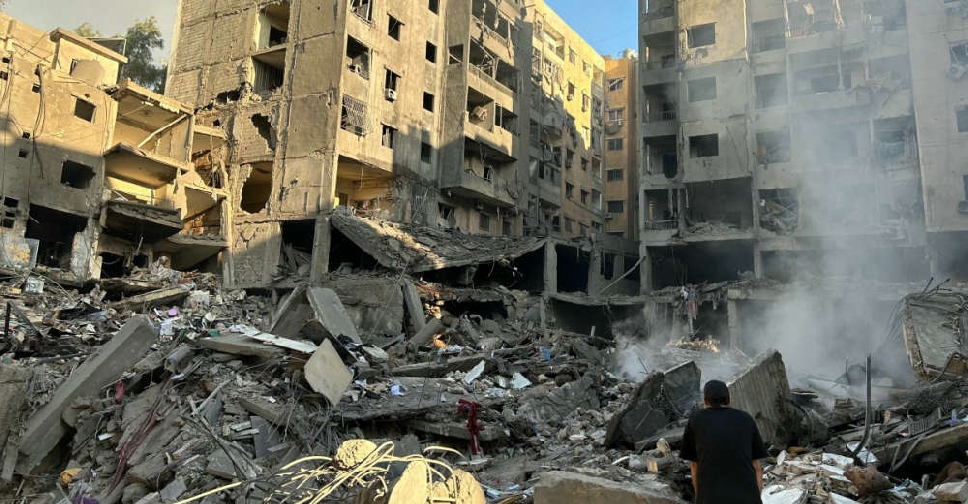
Israel launched airstrikes on Beirut's southern suburbs and other areas of Lebanon on Saturday, a day after carrying out a massive attack on Hezbollah's headquarters that appeared to be aimed at killing its leader, Sayyed Hassan Nasrallah.
The Israeli military said on Saturday it had killed Hezbollah leader Sayyed Hassan Nasrallah in an airstrike on the group's central headquarters in the southern suburbs of Beirut a day earlier.
The Iran-backed Hezbollah has yet to issue any statement on the status of Nasrallah, who has led the group for 32 years.
The Israeli military "eliminated ... Hassan Nasrallah, leader of the Hezbollah terrorist organization," Israeli army spokesperson Avichay Adraee wrote in a statement on X.
Hassan Nasrallah will no longer be able to terrorize the world.
— Israel Defense Forces (@IDF) September 28, 2024
"Hassan Nasrallah will no longer be able to terrorize the world," the Israeli military said in a post on X on Saturday.
Israel launched a new wave of airstrikes on Beirut's southern suburbs and other areas of Lebanon on Saturday, a day after carrying out the massive attack on the southern suburbs of Beirut known as Dahiyeh.
Reuters journalists heard more than 20 airstrikes in Beirut before dawn on Saturday and more after sunrise. Smoke could be seen rising over the city's Hezbollah-controlled southern suburbs, known as the Dahiyeh.
Thousands of people have fled the area since Friday's attack, congregating in squares, parks and sidewalks in downtown Beirut and seaside areas.
The Israeli military said a missile fired at central Israel on Saturday had struck an open area. Earlier, the military said about 10 projectiles had crossed from Lebanon into Israeli territory and that some had been intercepted.
The Israeli military also said it was striking Hezbollah targets in the Bekaa Valley, a region of eastern Lebanon at the Syrian border that it has pounded over the last week.
Israel's five hours of continuous strikes on Beirut early on Saturday followed Friday's attack, by far the most powerful by Israel on the city during the conflict with Hezbollah that has played out in parallel to the Gaza war for nearly a year.
The escalation has sharply increased fears the conflict could spiral out of control, potentially drawing in Iran, Hezbollah's principal backer, as well as the United States.

 Saudi-led coalition intercepts drone over Eastern Region
 Pakistan school roof collapse kills at least 32 children and a teacher
 China-North Korea bridge opens 12 years after completion
 Central Ukrainian region hit by vast drone attack, killing three