
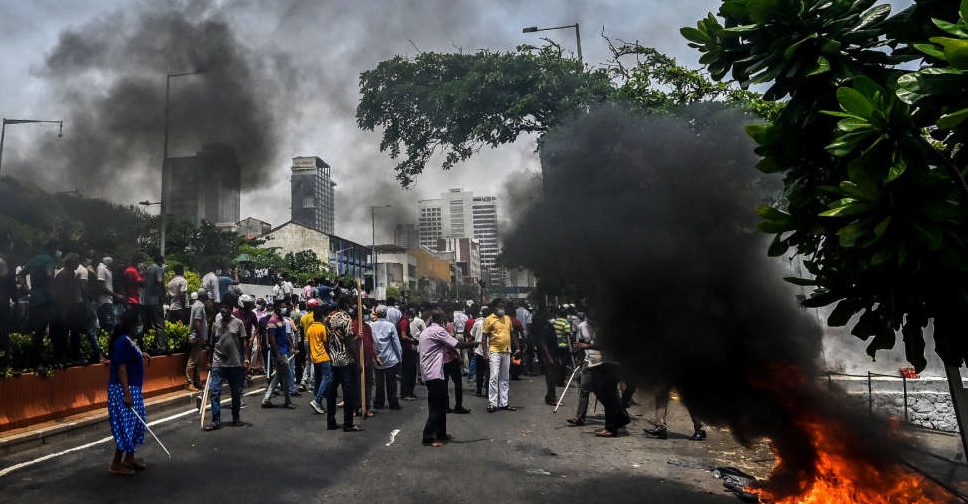
Sri Lanka's prime minister resigned on Monday, hours after clashes with pro- and anti-government demonstrators in the commercial capital Colombo amid the country's worst economic crisis that has spurred protests by thousands.
During weeks of unprecedented demonstrations, protesters across the island nation of 22 million people have demanded that President Gotabaya Rajapaksa and his elder brother, Prime Minister Mahinda Rajapaksa, quit for mishandling the economy.
In a statement, the prime minister's office said the 76-year-old veteran politician had resigned.
"A few moments ago, Prime Minister Mahinda Rajapaksa sent his letter of resignation to President Gotabaya Rajapaksa," the statement said.
In the letter, a copy of which was seen by Reuters, the prime minister said he was quitting to help form an interim, unity government.
"Multiple stakeholders have indicated the best solution to the present crisis is the formation of an interim all-party government," the letter said.
"Therefore, I have tendered my resignation so the next steps can be taken in accordance with the Constitution."
His departure came during a day of chaos and violence which culminated in police imposing a curfew across the country.
The confrontation began with hundreds of ruling party supporters rallying outside the prime minister's official residence before marching to an anti-government protest site outside the presidential office.
Police had formed a line ahead of time on the main road leading towards the site but did little to stop pro-government protesters from advancing, according to a Reuters witness.
Pro-government supporters, some armed with iron bars, attacked anti-government demonstrators at the "Gota Go Gama" tent village that sprang up last month and became the focal point of nationwide protests.
Police used tear gas rounds and water cannon to break up the confrontation, the first major clash between pro-and anti-government supporters since the protests began in late March.
At least nine people were taken to Colombo's National Hospital for treatment relating to injuries or tear-gas inhalation, a hospital official said, declining to be named.
Dozens of paramilitary troops with riot shields and helmets were deployed to keep both groups apart after the initial clashes. The army said it had also deployed soldiers in the area.
"Strongly condemn the violent acts taking place by those inciting & participating, irrespective of political allegiances," President Rajapaksa said in a tweet. "Violence won't solve the current problems."
'BANKRUPT NATION'
Hit hard by the pandemic, rising oil prices and tax cuts, Sri Lanka has as little as $50 million of useable foreign reserves, Finance Minister Ali Sabry said last week.
The government has approached the International Monetary Fund for a bailout, and will begin a virtual summit on Monday with IMF officials aimed at securing emergency assistance.
Facing escalating anti-government protests, Rajapaksa's government last week declared a state of emergency for the second time in five weeks, but public discontent has steadily simmered.
Long queues for cooking gas in recent days have frequently turned into impromptu protests as frustrated consumers blocked roads. Domestic energy companies said they were running low on stocks of liquid petroleum gas mainly used for cooking.
Sri Lanka needs at least 40,000 tonnes of gas each month, and the monthly import bill would be $40 million at current prices.
"We are a bankrupt nation," said W.H.K Wegapitiya, chairman of Laugfs Gas, one of the country's two main gas suppliers.
"Banks don't have sufficient dollars for us to open lines of credit and we cannot go to the black market. We are struggling to keep our businesses afloat."


 Powerful winter storm shuts schools, disrupts travel across US Northeast
 Mexican military kills cartel boss 'El Mencho' in US-backed raid
 Afghanistan says Pakistan strikes kill and injure dozens
 Police officer killed, dozens injured in bomb explosions in Ukraine's Lviv
 Trump pivots to new 15% global tariff after Supreme Court setback