

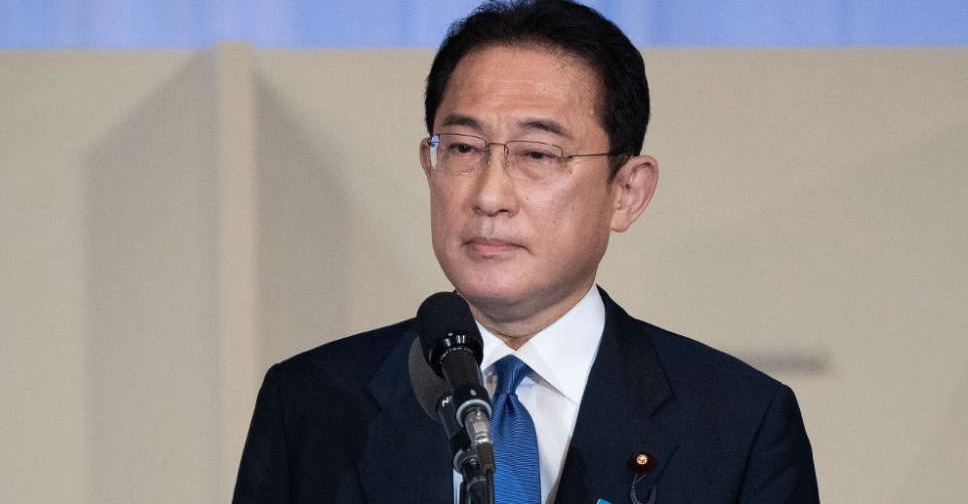
Former foreign minister Fumio Kishida won a ruling Liberal Democratic Party (LDP) leadership race on Wednesday, a victory that virtually ensures he will become Japan's next prime minister within days.
In an acceptance speech, Kishida vowed to lead a transformed party in a general election due within weeks and continue to fight the COVID-19 pandemic which has battered Japan's economy.
However, Kishida enjoys only moderate public support and has a bland image and his victory could spell problems for the LDP in the election due by November 28.
"The LDP leadership election is over. Let us all face the lower house and the upper house elections as one," Kishida said.
"Our national crisis continues. We need to keeping working hard on the coronavirus response with strong determination, and we need to compile tens of trillions of yen of stimulus package by the end of the year," he said.
Kishida defeated former defence and foreign minister Taro Kono, seen as an outspoken maverick, in a second round run-off vote. Two female contenders, Sanae Takaichi, 60, and Seiko Noda, 61, dropped out after the first round.
Kishida, who succeeds unpopular Prime Minister Yoshihide Suga who did not seek re-election as party leader after just one year in office, is almost certain to become premier at a parliamentary session on October 4 because of the LDP's majority in the lower house.
He is expected to form a new cabinet and reshuffle the LDP executive in early October.
Local media reported, quoting LDP executives, that the lower chamber will likely be dissolved in mid-October, with the election either November 7 or 14.
"A whole month of monopoly over TV and newspaper coverage in the run-up to the election cannot be bad for the LDP but the underwhelming result will dampen the celebratory mood quickly, possibly," said Koichi Nakano, political science professor, Sophia University.
"The opposition must be relieved that they don't have to fight against the darling of television (Kono)."
ESTABLISHMENT WIN
Kishida's victory is unlikely to trigger a huge shift in policies as Japan seeks to cope with an assertive China and revive an economy hit by the pandemic, with the soft-spoken MP highlighting the need to focus on reducing income disparity.
He shares a broad consensus on the need to boost Japan's defences and strengthen security ties with the United States and other partners including the QUAD grouping of Japan, the United States, Australia and India, while preserving vital economic ties with China and holding regular summit meetings.
Specifically, Kishida wants to beef up Japan's coast guard and backs passing of a resolution condemning China's treatment of members of the Uyghur minority. He wants to appoint a prime ministerial aide to monitor their human rights situation.
"Taiwan is the biggest question for me," said Jeffrey Hornung senior political scientist at RAND corporation.
Hornung said that the outgoing Suga administration had been publicly active in having conversations on Taiwan. "It will be interesting to see whether the new leader takes this approach, such as advocating for Taiwan's inclusion in CPTPP."
Kishida has said fiscal consolidation would be a major pillar of his policy and in the past has voiced doubts over the Bank of Japan's ultra-loose policy, saying in 2018 that stimulus cannot last forever.
But with the economy suffering from the COVID-19 pandemic, Kishida recently reversed course to say the BOJ must maintain its massive stimulus. He proposed a spending package of more than 30 trillion yen, adding that Japan likely would not raise a sales tax rate from 10 per cent "for about a decade".
He has stressed the need to distribute more wealth to households, in contrast to the focus of Abe's "Abenomics" policies on boosting corporate profits in the hope benefits trickle down to wage-earners.
"A win for the establishment. Kishida stands for stability, for not rocking the boat and most importantly, doing what elite technocrats tell him to do," Jesper Koll, expert director at Monex Group.


 Jordanian airspace reopens after 'comprehensive review'
 Iran vows to attack any ship trying to pass through Strait of Hormuz
 Drones target fuel tanks at Oman’s Duqm Port
 At least 42 civilians killed in Afghanistan in conflict with Pakistan, UN agency says
 Qatar announces interception of 2 jets, 101 missiles since Iranian attack