
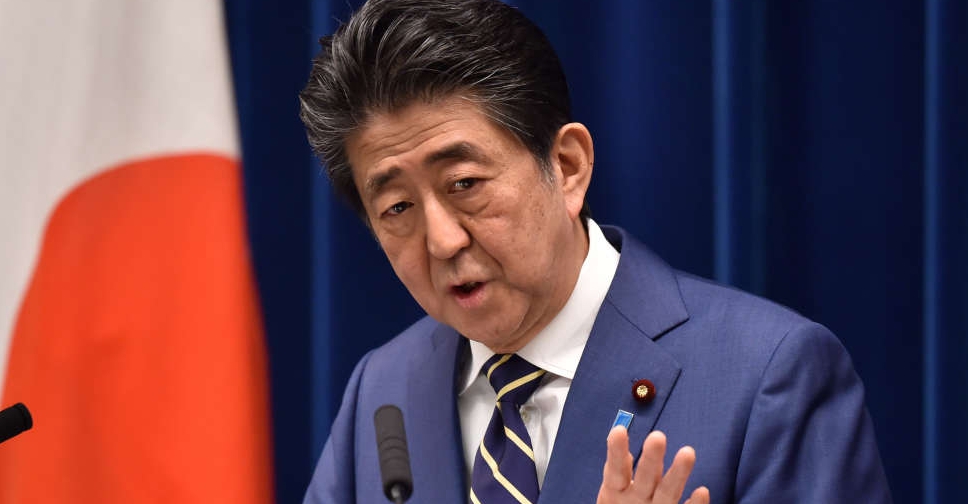
Japanese former prime minister Shinzo Abe was shot on Friday while campaigning in the city of Nara, a government spokesman said, with public broadcaster NHK saying he appeared to have been shot from behind by a man with a shotgun.
Chief Cabinet Secretary Hirokazu Matsuno said he did not know Abe's condition. Kyodo news agency and NHK said Abe, 67, appeared to be in a state of cardiac arrest when taken to hospital.
Shots were heard and a white puff of smoke was seen as Abe made a stump speech for a Sunday upper house election outside a train station in the western city, NHK said.
An NHK reporter on the scene said they could hear two consecutive bangs during Abe's speech.
Matsuno, told a briefing Abe had been shot at about 11:30 a.m. (0230 GMT), adding, "Such an act of barbarity cannot be tolerated."
TBS Television reported that Abe had been shot on the left side of his chest and apparently also in the neck.
Abe served two terms as prime minister to become Japan's longest-serving premier before stepping down in 2020 citing ill health.
But he has remained a dominant presence over the ruling Liberal Democratic party (LDP) party, controlling one of its major factions.
His protege, Prime Minister Fumio Kishida, goes into an upper house election on Sunday hoping, analysts say, to emerge from Abe's shadow and define his premiership.
Kishida suspended his election campaign after Abe's shooting and was returning to Tokyo, media reported.
The ambassador of the United States, Rahm Emanuel, said he was saddened and shocked by the shooting of an outstanding leader and unwavering ally. The U.S. government and people were praying for Abe's well-being, he said.
Abe has been best known for his signature “Abenomics” policy featured bold monetary easing and fiscal spending.
He also bolstered defence spending after years of declines and expanded the military’s ability to project power abroad.
In a historic shift in 2014, his government reinterpreted the postwar, pacifist constitution to allow troops to fight overseas for the first time since World War Two.
The following year, legislation ended a ban on exercising the right of collective self-defence, or defending a friendly country under attack.
Abe, however, did not achieve his long-held goal of revising the U.S.-drafted constitution by writing the Self-Defense Forces, as Japan’s military in known, into the pacifist Article 9.
He was instrumental in winning the 2020 Olympics for Tokyo, cherishing a wish to preside over the Games, which were postponed by a year to 2021 because of the COVID-19 pandemic.
Abe first took office in 2006 as Japan’s youngest prime minister since World War Two. After a year plagued by political scandals, voter outrage at lost pension records, and an election drubbing for his ruling party, Abe quit citing ill health.
He became prime minister again in 2012.
Abe hails from a wealthy political family that included a foreign minister father and a great-uncle who served as premier.


 Qatar busts two cells linked to Iran’s Revolutionary Guard
 Jordanian airspace reopens after 'comprehensive review'
 Iran vows to attack any ship trying to pass through Strait of Hormuz
 Drones target fuel tanks at Oman’s Duqm Port
 At least 42 civilians killed in Afghanistan in conflict with Pakistan, UN agency says