

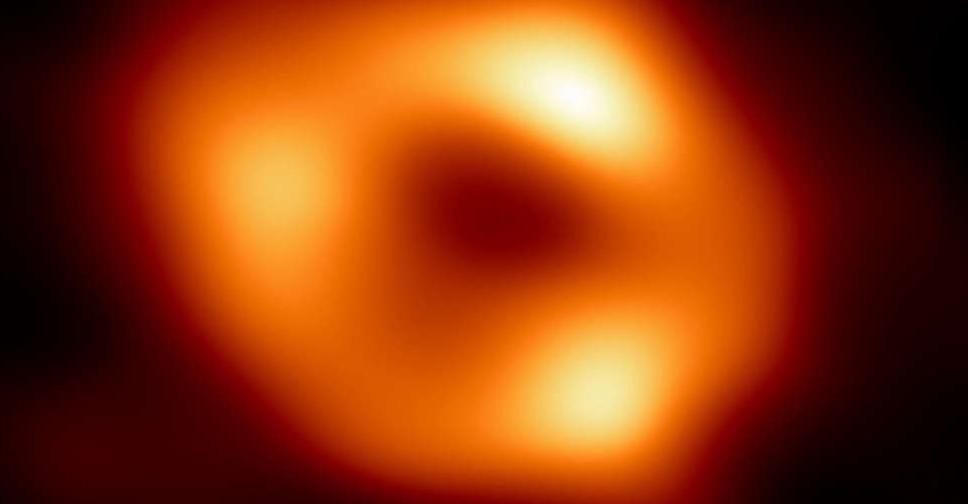
Scientists on Thursday provided the first look at the "gentle giant" lurking at the center of our Milky Way galaxy - an image of a supermassive black hole that devours any matter within its huge gravitational pull but is currently on a bit of a diet.
The black hole - called Sagittarius A*, or Sgr A* - is the second one ever to be imaged. The feat was accomplished by the same Event Horizon Telescope (EHT) international collaboration that in 2019 unveiled the first photo of a black hole - that one residing at the heart of a different galaxy.
University of Arizona astronomer Feryal Özel, at a news conference in Washington, hailed "the first direct image of the gentle giant in the center of our galaxy," showing a glowing ring of red, yellow and white surrounding a darker center.
Sagittarius A* (pronounced Sagittarius "A" star) possesses 4 million times the mass of our sun and is located about 26,000 light-years - the distance light travels in a year, 5.9 trillion miles (9.5 trillion km) - from Earth.
Harvard-Smithsonian Center for Astrophysics astrophysicist Michael Johnson called Sagittarius A* "ravenous but inefficient," currently eating relatively little matter.
"If Sgr A* were a person, it would consume a single grain of rice every million years," Johnson said. It is putting out only a few hundred times the energy of the sun despite being much more massive.
Black holes are extraordinarily dense objects with gravity so strong that not even light can escape, making viewing them extremely challenging. A black hole's event horizon is the point of no return beyond which anything - stars, planets, gas, dust and all forms of electromagnetic radiation - gets dragged into oblivion.
The image was obtained using the EHT's global network of observatories working collectively to observe radio sources associated with black holes. It showed a ring of light - super-heated disrupted matter and radiation circling at tremendous speed at the edge of the event horizon - around a region of darkness representing the actual black hole. This is called the black hole's shadow or silhouette.
Imaging it was complicated by its dynamic environment including swirling gas around it - as Özel put it: "a source that burbled and gurgled as we looked at it."
"We love our black hole," Özel said.
The Milky Way is a spiral galaxy that contains at least 100 billion stars. Viewed from above or below it resembles a spinning pinwheel, with our sun situated on one of the spiral arms and Sagittarius A* located at the center.
'JUST TRICKLING IN'
Scientists are trying to better understand how supermassive black holes form early in a galaxy's history and evolve over time.
"They go through periods where there is a lot of material around them," Özel said. "... And then they go through these quiescent phases like the one at the center of our galaxy where matter is just trickling in."
The image released in 2019 showed the supermassive black hole in a galaxy called Messier 87, or M87. That one was far more distant and massive than Sagittarius A*, situated about 54 million light-years from Earth with a mass 6.5 billion times that of our sun.
Sagittarius A*, despite being much closer to our solar system than M87, was harder to image. The diameter of Sagittarius A* is about 17 times that of the sun, meaning it would sit within the innermost planet Mercury's solar orbit. In contrast, M87's diameter would encompass the entirety of our solar system.
Harvard-Smithsonian Center for Astrophysics radio astronomer Lindy Blackburn said that "the smaller physical size of Sgr A* also means that everything changes about a thousand times faster for Sgr A* than M87. We must also peer through the messy disk of our own galaxy to view Sgr A*, which blurs and distorts the image."
Johnson said both black hole images appear blurry because obtaining them pushed the capability of the telescopes "to the breaking point." MIT Haystack Observatory astronomer Vincent Fish said the researchers hope to obtain M87 black hole video in the future.
Thursday's announcement was made in news conferences at seven sites worldwide. EHT Project Director Huib Jan van Langevelde in Germany voiced excitement over finally unmasking the enigma that had been Sagittarius A*.
"I think it's just super exciting," said Caltech computer scientist Katie Bouman. "What's more cool than seeing the black hole at the center of our own Milky Way?"


 Afghanistan says Pakistan strikes kill and injure dozens
 Police officer killed, dozens injured in bomb explosions in Ukraine's Lviv
 Trump pivots to new 15% global tariff after Supreme Court setback
 Hong Kong plans to buy homes devastated in deadly high-rise fire
 US Supreme Court strikes down Trump's global tariffs