
Australia's ruling conservative coalition cannot win enough seats to form a government, two television stations projected on Saturday after the government lost ground to climate-focused independents and smaller parties.
The struggles of Prime Minister Scott Morrison's Liberal-National coalition, and to a lesser extent the opposition Labor Party led by Anthony Albanese, raised the prospect of a hung parliament and a period of uncertainty while a record number of postal votes are counted.
"At the moment, I can't see the coalition getting to a majority on these numbers," the Australian Broadcasting Corp's election analyst Antony Green said in a live broadcast.
Sky News projected the ruling coalition "can't win a majority".
Centre-left Labor had held a decent lead in opinion polls after nine years in opposition, although recent surveys showed the Liberal-National government narrowing the gap in the final stretch of a six-week campaign.
A Newspoll survey by The Australian newspaper out on election day showed Labor's lead over the ruling coalition dipping a point to 53-47 on a two-party-preferred basis, where votes for unsuccessful candidates are redistributed to the top two contenders.
But growing dissatisfaction over policies, candidate selection and integrity saw voters turn away from both major parties.
TURNING TEAL
In several affluent Liberal-held seats, so-called "teal independents" campaigning for action on climate change after some of the worst floods and fires to hit Australia, looked likely to win.
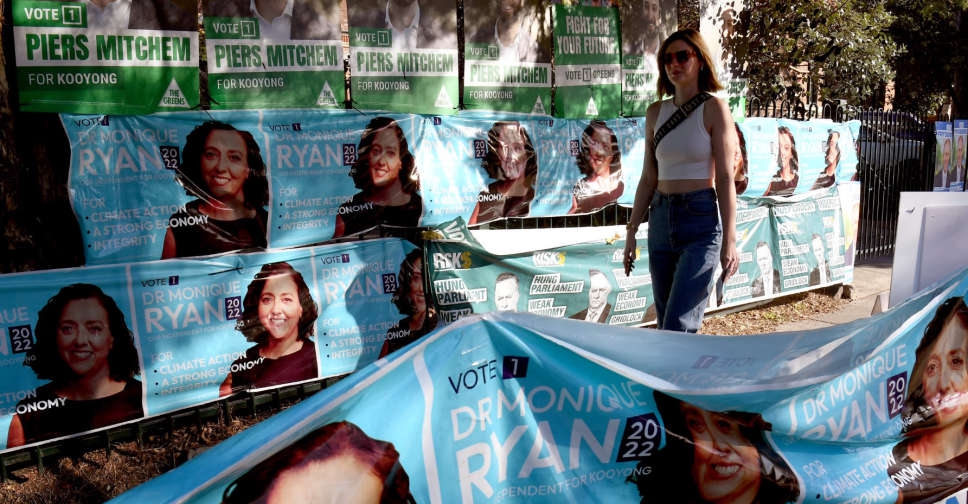
Three volunteers working for teal independent Monique Ryan, who is running against Treasurer Josh Frydenberg in the long-held Liberal seat of Kooyong in Melbourne, said they joined Ryan's campaign because they are concerned about the climate for the sake of their children and grandchildren.
"For me, it's like this election actually feels hopeful," Charlotte Forwood, a working mother of three adult children, told Reuters.
With 82 per cent of polling booths counted, Ryan was projected to win 53 per cent of the two-party preferred vote.
Early returns suggested the Greens had also made ground, especially in some urban centres, while billionaire Clive Palmer's United Australia Party and Pauline Hanson's right-wing One Nation also looked to have gained votes at the expense of both major parties.
Greens leader Adam Bandt, who retained his inner-city Melbourne seat, said climate was a major issue for voters.
"There was an attempt from Labor and Liberal to bury it, and we were very clear about the need to tackle climate by tackling coal and gas."
Morrison and Albanese earlier cast their votes in Sydney after making whistle-stop tours across marginal seats in the final two days of a campaign dominated by rising living costs, climate change and integrity.
As Labor focussed on spiking inflation and sluggish wage growth, Morrison made the country's lowest unemployment in almost half a century the centrepiece of his campaign's final hours.
In the outgoing parliament, the Liberal-National coalition held 76 of the 151 lower house seats, while Labor held 68, with seven minor party and independent members.
Voting is compulsory and more than half of the votes had been cast by Friday evening, with a record 8 million early in-person and postal votes, the Australian Electoral Commission said.
The commission has cautioned that a clear winner might not immediately emerge if it is a close contest, due to the time required to count about 3 million postal votes.


 Afghanistan says Pakistan strikes kill and injure dozens
 Police officer killed, dozens injured in bomb explosions in Ukraine's Lviv
 Trump pivots to new 15% global tariff after Supreme Court setback
 Hong Kong plans to buy homes devastated in deadly high-rise fire
 US Supreme Court strikes down Trump's global tariffs